What Connecticut Homeowners Need to Know About the January 2026 Rate Increase
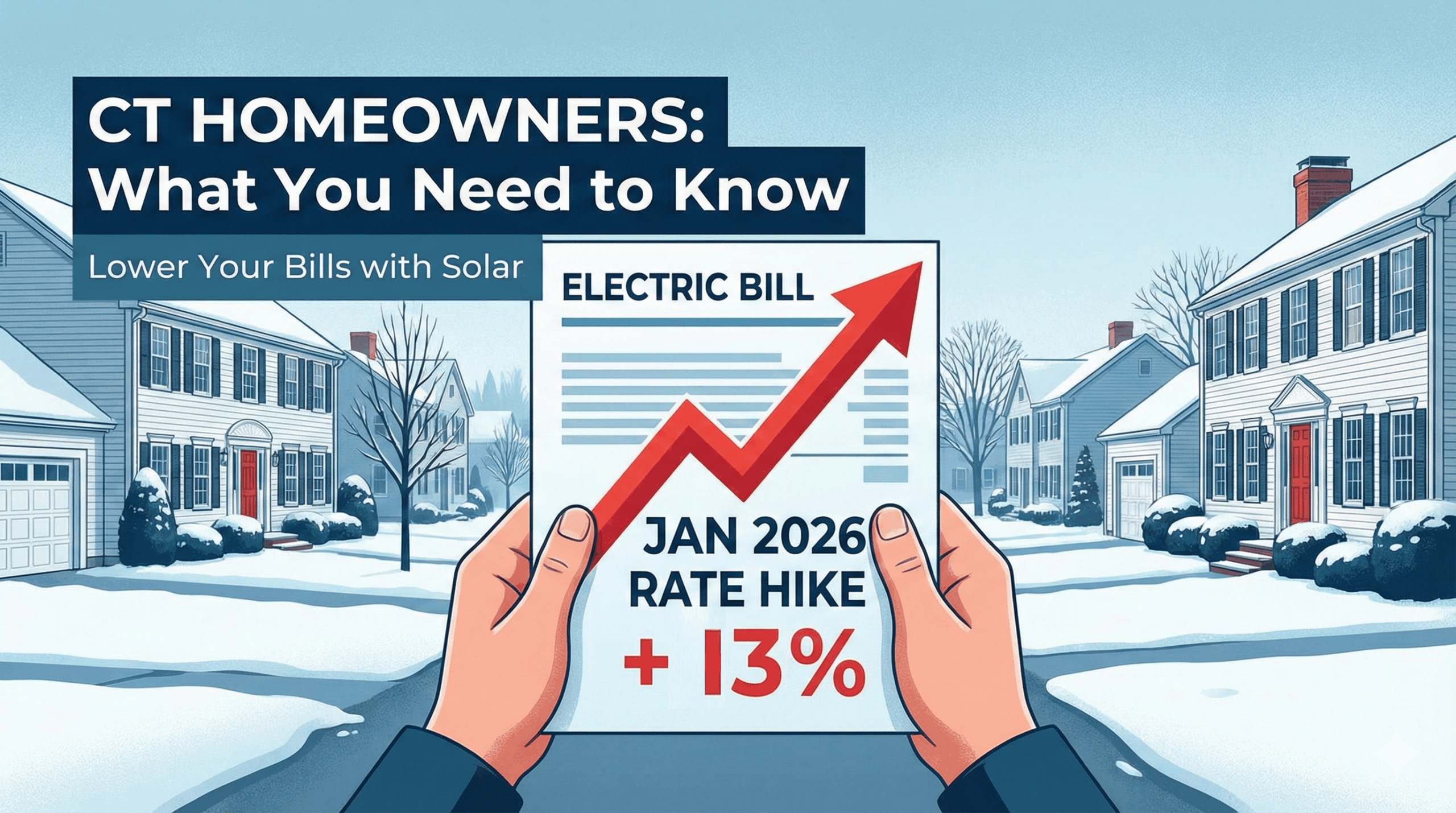
If you're a Connecticut homeowner, you've probably noticed your January electric bill is higher than expected. You're not imagining things—and you're definitely not alone. The supply rate for electricity just jumped nearly 30%, translating to an extra $20 per month for the average household using 700 kWh.
Before you feel helpless about rising costs, let's break down exactly what happened, what it means for your wallet, and—most importantly—what options you have to take control of your energy future.
The January 2026 Rate Increase: The Numbers You Need to Know
Let's start with the facts. The Connecticut Public Utilities Regulatory Authority (PURA) approved a significant rate adjustment that took effect this month:
- Supply Rate Jump: From 9.748¢ per kWh (July–December 2025) to 12.641¢ per kWh—a roughly 29.7% increase in the supply portion of your bill
- Monthly Bill Impact: For an average homeowner using 700 kWh per month, this translates to approximately $20 more per month, or $240 annually
- Historical Context: While this rate is higher than the preceding summer period, it represents a 13% increase specifically compared to last winter's rate of 11.19¢ per kWh
If you're on a fixed income, managing a tight family budget, or recently electrified your home with heat pumps, that $20–$40 monthly increase isn't just a number—it's a real squeeze on what you can afford.
Understanding Your Electric Bill: Where Does Your Money Actually Go?
Most Connecticut homeowners don't realize their electric bill is actually made up of three distinct components. Understanding this breakdown is crucial because it reveals where you have control—and where you don't.
1. Supply Charges (~50% of Your Bill)
Generation Service Charge: This is the actual cost of the electricity you used. Your utility company passes this cost from power plants directly to you without any profit mark-up.
The Key Insight: This is the portion that just increased by 29.7%. While you can shop for cheaper third-party suppliers at EnergizeCT.com, Connecticut homeowners have discovered something even more effective: eliminating this charge entirely by generating your own power.
2. Delivery Charges (~40% of Your Bill)
Transmission & Distribution: These cover the cost of maintaining the physical grid—poles, wires, substations—and providing customer service.
Customer Charge: A flat monthly fee that covers fixed costs like meter reading and billing.
Important to Know: Your utility company makes its profit on delivery, not on the supply of electricity. When supply rates go up, it's because the wholesale cost of energy (largely natural gas in New England) has increased—not because the utility is pocketing more money.
3. Public Benefits Charges (~10% of Your Bill)
State-Mandated Programs: These fees fund state energy efficiency programs, low-income assistance, and renewable energy incentives. Connecticut lawmakers recently reduced some of these charges to help offset the supply price increases.
Why This Rate Increase Feels Different
If you're feeling frustrated right now, you have every right to be. Rate volatility isn't just inconvenient—it makes budgeting nearly impossible. Consider these scenarios:
For Retirees on Fixed Incomes: You carefully planned your retirement budget, factoring in predictable expenses. Now your electric bill swings from $300 to $450 seasonally, eating into savings you worked decades to build. How are you supposed to plan for healthcare, travel, or helping your grandchildren when your utility bill acts like a slot machine?
For Growing Families on Tight Budgets: That $20–$40 monthly increase is groceries for the week. It's the difference between having breathing room and constantly feeling squeezed. And the worst part? You can't predict what rates will be next winter—or the one after that.
For Homeowners Who Recently Electrified: You did the right thing—you switched from oil heat to efficient heat pumps to save money and help the environment. But now your winter electric bills have doubled from what they were before electrification. The environmental benefits feel hollow when you're anxious about running the heat comfortably in your own home.
The Pattern You Need to Understand
Here's what Connecticut homeowners are starting to realize: This isn't just about one rate increase. It's about the fundamental structure of how you pay for electricity.
Right now, you're essentially renting your electricity month-to-month at whatever price the market dictates. And just like renting an apartment, you have no control over when or how much the price increases.
Ask yourself: If rates went up another 10% next year—or even 20%—how would that feel? Would you be able to absorb that? Would you have to make difficult choices about comfort vs. cost?
What Smart Connecticut Homeowners Are Doing Instead
More Connecticut families are asking a different question: What if instead of renting electricity at volatile rates, you could own your power source at a fixed cost?
That's exactly what solar energy offers—not as a "green" luxury, but as a financial tool to lock in predictable energy costs for the next 25 years.
Here's how it works in practical terms:
- Fixed Monthly Payment: Instead of paying the utility whatever they charge (which just went up 30%), you make a fixed monthly payment for your solar system. Most Connecticut homeowners find this payment is lower than what they were paying the utility—and it never increases.
- Immediate Savings: The "bill swap" happens from Day 1. You're not waiting years to break even—you're saving money on your first bill.
- Zero Down Options: Connecticut's Smart-E loan program and other financing options mean you don't need $30,000 in cash. You can start saving immediately with $0 down.
- Protection from Future Increases: When rates go up again next year (and the year after that), your solar payment stays exactly the same. While your neighbors are absorbing another 10–20% increase, you're insulated.
How This Looks for Real Connecticut Families
The Retiree Scenario:
Ron is 68, lives in Cheshire, and his home is paid off. His electric bill swings from $280 to $450 depending on the season. He was quoted a solar system with a $240 monthly loan payment that's fixed for 20 years. Not only is he paying less than his average utility bill, but he knows exactly what he'll be paying in 2030, 2035, and 2040. The peace of mind alone is worth it.
The Young Family Scenario:
Bob and Sarah have two kids and live in Bristol. Their electric bill is $350/month and climbing with each rate increase. They were nervous about taking on more debt, but when they saw they could get solar for $240/month with zero down, it was a no-brainer. That's $110 in monthly savings they can put toward daycare, groceries, or family activities.
The Heat Pump Scenario:
Hannah switched from oil to heat pumps last year, excited to save money and reduce her carbon footprint. But her winter electric bills shot up to $600/month, making her second-guess her decision. Adding solar was like pre-buying 25 years of heating fuel at today's prices. Now she runs her heat pumps guilt-free, knowing she's locked in a fixed cost.
Why Local Matters When Making This Decision
If you're considering solar, here's something important to know: Not all solar companies are created equal. Many of the biggest names you see advertising are national call centers that subcontract the actual installation work to whoever is cheapest.
When you're making a 25-year investment, you want a partner who will actually be around in 5, 10, or 15 years when you need them. You want a company where:
- Your phone call goes to a local office, not a call center in another state
- The same team that designs your system also installs it—no subcontractors who disappear after the job
- You have one warranty, one phone number, one throat to choke if anything goes wrong
Family-owned, Bristol-based companies like SAVKAT have been installing solar in Connecticut since 2017, with over 3,500 completed installations. When issues arise, local trucks roll out—not excuses.
What to Do Next
If reading about this rate increase has you thinking "there has to be a better way," you're right. The question is: What will you do about it?
Here's your simple three-step plan:
- Step 1: Calculate Your Actual Cost of Waiting. If you continue paying the utility at current rates, you'll spend thousands more over the next 12 months alone. Solar isn't just about saving money—it's about stopping the bleeding.
- Step 2: Get a Custom Analysis. Every home is different. Your roof orientation, electrical usage, and financing options determine what makes sense for you. A 15-minute conversation with a local solar advisor can show you exactly what your fixed payment would be versus your current volatile bill.
- Step 3: Make the Decision That's Right for Your Family. Not every home is a good fit for solar—and that's okay. But you owe it to yourself to at least find out where you stand. The worst decision is no decision, especially when rates are trending upward.
The Bottom Line
The January 2026 rate increase is frustrating, but it doesn't have to be permanent. Connecticut homeowners are discovering they don't have to accept volatile energy costs as a fact of life.
You have options. You have control. And you have local companies ready to help you take it back.
The question isn't "Can I afford solar?" It's "Can I afford to keep renting electricity at prices I can't predict?"
Ready to Stop Renting Your Power?
Contact SAVKAT for a free, no-pressure solar analysis custom-designed for your Connecticut home. Find out exactly what your fixed payment would be versus your current utility bill.
🌐 Visit: www.savkat.com
📍 71 Dolphin Road, Bristol, CT 06010
Disclaimer:
This article provides general information about Connecticut electricity rates and solar energy options. Rate information is based on publicly available data from the Connecticut Public Utilities Regulatory Authority (PURA) and is subject to change. Individual savings and system performance will vary based on factors including roof orientation, shading, electricity usage, financing terms, and available incentives.
Solar panel systems are long-term investments. SAVKAT recommends consulting with a licensed solar advisor to determine if solar is right for your specific situation. All financing options, including the Smart-E loan program, are subject to credit approval and program availability. The 30% federal Investment Tax Credit (ITC) is subject to change based on federal legislation.
SAVKAT, Inc. is a licensed solar contractor in Connecticut and complies with all applicable PURA regulations. For more information about Connecticut solar programs and regulations, visit portal.ct.gov/pura.
Stop Overpaying for Electricity
See what 3,500+ CT homeowners already discovered.